A small business may be able to borrow anywhere from a few thousand dollars to several million dollars, depending on the type of financing. Whether you’re exploring Small Business Loans or other funding options, lenders consider factors such as revenue, cash flow, credit score, collateral, and loan purpose. In this article, we explore how lenders decide loan amounts, what SBA limits mean, how monthly revenue affects borrowing power, and how business owners can compare funding options without taking on more debt than they can handle. The right amount is not always the highest number on the table—it is the amount your business can comfortably repay while still keeping enough cash in the bank to run the company.
How Much Can a Small Business Borrow With a Business Loan?
The honest answer is: it depends on the business, the lender, and the loan type. A newer company with modest monthly revenue may qualify for a smaller working capital loan. A seasoned company with strong cash flow, clean financials, and collateral may qualify for a larger term loan, SBA loan, business line of credit, or commercial real estate loan.
In broad terms, many small business loan amounts start around $5,000 to $10,000 and can rise to $500,000, $1 million, $5 million, or more for qualified borrowers. Dash Capital’s funding platform presents options from $10,000 to $5 million, with repayment terms that may range from six months to 10 years, depending on the product, lender review, and approval. Business owners who want to compare options can start with Dash Capital’s fast business funding process before they choose a loan amount.
For Livonia business owners, Metro Detroit companies, and Michigan small businesses that need capital without the usual bank slowdown, Dash Capital helps compare possible funding options for working capital, term loans, lines of credit, SBA loans, equipment financing, and invoice-based solutions. Dash Capital is a business loan broker, not a direct lender, so the final loan amount, approval, rate, terms, and funding timeline depend on each lender’s underwriting review.
The better question is not only how much can a small business borrow with a business loan, but how much it should borrow. That is where cash flow, monthly payment comfort, lender requirements, and return on investment matter.
Typical Business Loan Amounts by Type of Loan
Different types of business loans serve different jobs. A business line of credit might be best for short-term cash flow. A term business loan may fit expansion, equipment, hiring, or renovation. SBA loans may work for larger, longer-term financing when the borrower meets SBA loan requirements and can wait through a more detailed process.
| Type of loan | Typical borrowing range | Best use | Common repayment style |
| Working capital loan | $5,000 to $500,000+ | Payroll, inventory, marketing, repairs, seasonal gaps | Daily, weekly, or monthly payments |
| Business line of credit | $10,000 to $500,000+ | Flexible cash access when needed | Revolving draws and repayments |
| Small business term loan | $25,000 to $2 million+ | Expansion, equipment, renovation, hiring | Fixed payments over a set term |
| SBA 7(a) loan | Up to $5 million | Working capital, debt refinance, business acquisition, equipment, and real estate | Monthly payments, often with longer terms |
| SBA Express loan | Up to $500,000 | Faster SBA-backed funding for eligible businesses | Term loan or line of credit structure |
| SBA 504 loan | Up to $5.5 million | Major fixed assets, real estate, and large equipment | Long-term fixed-rate structure |
| SBA microloan | Up to $50,000 | Startups, small equipment, supplies, inventory, and working capital | Usually shorter fixed repayment |
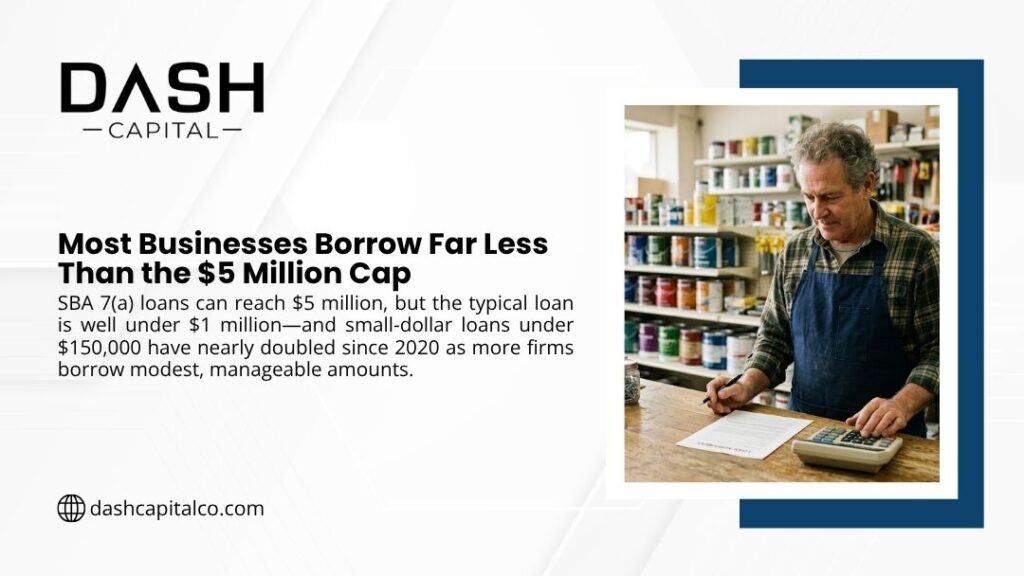
The U.S. Small Business Administration states, “The maximum loan amount for a 7(a) loan is $5 million.” That matters because an SBA 7(a) loan can support larger working capital needs, business acquisitions, equipment purchases, refinancing, and certain real estate uses when the borrower qualifies. The SBA also confirms that microloans provide up to $50,000, while 504 loans can reach $5.5 million for major fixed assets.
What Lenders Look at Before They Decide Your Loan Amount
Lenders do not approve a loan amount just because a business owner asks for it. They look at whether the company can repay it. That review can feel a little personal, but it is mostly about risk.
Cash flow is usually the first checkpoint. If your business brings in steady revenue and has enough money left after payroll, rent, suppliers, taxes, debt payments, and other operating costs, lenders may feel more comfortable approving a larger amount. If revenue swings up and down, they may offer less or recommend a business line of credit instead of a large lump-sum loan.
Credit score matters too. Some lenders focus heavily on personal and business credit. Others care more about revenue and bank statements, especially for working capital. A strong credit score can help with better business loan rates, longer business loan terms, and a higher approval amount. Weak credit does not always close the door, but it can reduce the amount, raise the interest rate, or shorten the repayment term.
Time in business is another big one. A business with two or more years of operating history gives lenders more proof. A newer company may still qualify, but it may need stronger revenue, a smaller request, collateral, or a personal guarantee. Dash Capital’s funding approach is built for business owners who want a simpler path than a traditional bank process, but lender review still matters.
Collateral can also change the offer. A secured small business loan backed by equipment, inventory, vehicles, receivables, or real estate may support a larger amount or a lower interest rate. An unsecured loan can be faster and easier in some cases, but because the lender takes more risk, the amount may be lower, or the cost may be higher.
Loan Amount Examples by Monthly Revenue
A loan calculator can help, but many business owners need a plain-English starting point. Monthly revenue does not decide everything, yet it gives lenders a first look at borrowing power. Cash flow, margins, existing debt, industry risk, and bank activity still affect the final number.
| Average monthly revenue | Conservative funding range | Possible fit | What lenders may check closely |
| $15,000 to $25,000 | $5,000 to $35,000 | Working capital, small inventory purchase, emergency repair | Bank deposits, negative days, existing debt |
| $25,000 to $50,000 | $20,000 to $100,000 | Payroll support, marketing, equipment, and seasonal cash gap | Cash flow, repayment history, and credit score |
| $50,000 to $100,000 | $50,000 to $250,000 | Larger working capital, expansion prep, and equipment | Margins, debt load, business stability |
| $100,000 to $250,000 | $100,000 to $750,000 | Term loan, line of credit, multi-location growth | Tax returns, financial statements, collateral |
| $250,000+ | $250,000 to $2 million+ | Acquisition, real estate, major equipment, SBA loan | Debt-service capacity, industry, collateral, lender limits |
These are examples, not promises. Loan approval, amount, interest rate, fees, repayment schedule, and funding speed depend on lender underwriting, business performance, credit profile, documents, and use of funds.
The Simple Borrowing Formula Business Owners Should Use
A lender may offer a high number. That does not mean the business should take it. Before signing, run the loan through a simple test: can the business make the payment during an average month, not just a great month? Here is a practical way to think about it.
| Monthly cash left after core expenses | Safer monthly loan payment range | Why it matters |
| $5,000 | $1,000 to $1,500 | Keeps room for slow weeks and surprise costs |
| $10,000 | $2,000 to $3,000 | Allows growth funding without draining operations |
| $25,000 | $5,000 to $7,500 | Supports larger term loans if revenue is stable |
| $50,000 | $10,000 to $15,000 | May support expansion or acquisition financing |
This is not a lender rule. It is a safety check. A business with predictable contracts, strong margins, and low existing debt may handle more. A restaurant in Livonia, a contractor in Metro Detroit, a medical practice in Michigan, or a seasonal retail shop may need more breathing room. And that’s why it matters: the loan should help the business move forward, not turn every Monday morning into a cash-flow fire drill.
SBA Loan Limits and What They Mean for Small Businesses
SBA loans are often misunderstood. An SBA loan is not usually money handed directly from the SBA to the borrower. In most cases, an approved lender makes the loan, and the SBA guarantees part of it. That guarantee reduces lender risk and can make approval possible for eligible small businesses.
The SBA 7(a) loan program is the best-known SBA business loan. It can be used for short-term and long-term working capital, refinancing business debt, buying equipment, buying a business, purchasing furniture and supplies, and certain real estate needs. The SBA 7(a) loan maximum is $5 million.
The SBA Express loan is part of the 7(a) family but has a lower limit of $500,000. It may appeal to business owners who want a faster SBA-backed route, though approval still depends on SBA loan qualifications, lender review, creditworthiness, and repayment ability.
The SBA 504 loan program is different. It is mainly for major fixed assets, such as commercial property, large equipment, construction, and facility improvements. It can reach up to $5.5 million, but it is not meant for ordinary working capital or inventory.
The SBA microloan program is smaller. It offers loans up to $50,000 and is often used for inventory, supplies, furniture, fixtures, machinery, equipment, and working capital. For small businesses that do not need a large business loan, a microloan can be a better fit than taking on more debt than necessary.
Business Loan Interest Rates and Borrowing Power
Interest rate affects borrowing power because it affects the monthly payment. A $100,000 loan at a low rate over five years is very different from a $100,000 short-term loan with a high APR or factor rate.
As of June 2026, the Federal Reserve Bank of St. Louis FRED series for the bank prime loan rate showed prime at 6.75% on June 22, 2026. Because rates change, business owners should confirm current business loan rates and current SBA loan rates before they apply.
SBA 7(a) variable rates are tied to a base rate, such as prime, plus an allowed spread. That means SBA loan rates today depend on the loan size, term, lender, and borrower profile. For example, SBA 7(a) variable-rate loans above $350,000 may not exceed the base rate plus 3.0%, while smaller SBA 7(a) loans can carry higher allowed spreads. This is one reason larger SBA loans may sometimes price more favorably than smaller loans, even though they are harder to qualify for.
For non-SBA financing, business loan interest rates can vary widely. Bank loans may offer lower rates to strong borrowers. Online lenders may approve faster and accept more flexible profiles, but often at a higher cost. Working capital loans may help when timing matters, especially if the business needs funding in days rather than weeks.
Dash Capital’s working capital funding options are built for short-term needs such as payroll, inventory, marketing, emergency repairs, or seasonal slowdowns. For longer-term growth, Dash Capital also explains business term loan options that may be better suited for expansion, equipment, hiring, or renovation.
How Much Business Loan Can I Get If My Business Is New?
New business owners often ask how to get a loan to start a business, but startup funding is usually harder than funding for an established company. A lender cannot study years of bank statements, tax returns, or sales trends if the business has not been operating long.
That does not mean new businesses have no options. A startup may qualify through a smaller loan, an SBA microloan, equipment financing, business credit cards, a secured loan, or a personal loan for business use. Some lenders may also consider projected revenue, owner credit, collateral, industry experience, or whether the owner is buying an existing business with proven income.
Still, the amount is usually more conservative. A lender may approve enough to cover specific startup costs, not a large, open-ended request. New businesses should be careful here. Borrowing too much early can hurt cash flow before sales become steady.
Small Loan or Large Loan: Which One Fits Best?
A small business loan should match the job it is meant to do. If the goal is to buy inventory for the next 60 days, a large long-term loan may be too much. If the goal is to buy a commercial property, a short-term working capital loan may be the wrong tool.
| Business need | Better fit | Why |
| Cover payroll during a slow month | Working capital loan | Fast access and short-term use |
| Handle uneven cash flow | Business line of credit | Borrow only when needed |
| Buy equipment | Equipment financing or term loan | Payment can match asset use |
| Expand a location | Term loan or SBA 7(a) loan | Longer repayment can protect cash flow |
| Buy commercial real estate | SBA 504 or SBA 7(a) loan | Larger amount and longer term |
| Buy another business | SBA 7(a) or acquisition loan | Structured for change of ownership |
| Need less than $50,000 | Microloan or small business loan | Lower debt burden |
Here’s the thing: bigger is not always better. A large business loan can support growth, but it also raises the monthly obligation. A smaller loan can be easier to manage, especially if the business needs cash to bridge a gap rather than fund a major expansion.
Business Loan Examples by Industry
A loan amount should make sense for the industry. A contractor may need cash for materials before a project pays out. A restaurant may need working capital for payroll, food orders, or patio repairs before the busy season. A medical office may need financing for equipment, software, or build-out costs. Retail Business Loans can help retailers purchase inventory before a holiday rush, manage seasonal demand, and maintain healthy cash flow. Likewise, Gym Business Loans can help fitness centers invest in new equipment or facility upgrades, while Hotel Business Loans can provide funding for renovations, property improvements, or seasonal operating expenses.
For a Metro Detroit contractor with signed jobs and strong deposits, a line of credit or working capital loan may help cover labor and materials until invoices clear. For a Livonia restaurant, a smaller short-term loan may be safer than a large long-term loan if the need is seasonal. For a Michigan medical practice, a term loan may make more sense if the funds will buy equipment that supports revenue for several years.
This is where a funding conversation beats a guess. The same $100,000 loan can be sensible for one company and risky for another. It depends on margins, timing, repayment schedule, and whether the money creates a return.
Are Small Business Loans Secured or Unsecured?
Small business loans can be secured or unsecured. A secured business loan uses collateral. That collateral might be real estate, equipment, inventory, receivables, or other business assets. A secured structure may help a business qualify for more money or better rates, especially if the loan amount is large.
An unsecured small business loan does not require specific collateral in the same way, though a personal guarantee may still be required. Many business owners like unsecured loans because they can be faster and less paperwork-heavy. But since the lender has less security, the approved amount may be smaller, the repayment term may be shorter, or the interest rate may be higher.
Dash Capital’s small business loan products include working capital, term loans, lines of credit, SBA loans, equipment financing, and other funding options. That range helps because the best type of loan depends on why the business needs money in the first place.
How to Estimate the Right Loan Amount Before You Apply
Before applying, business owners should write down the exact use of funds. A vague request like “I need cash for growth” is weaker than “I need $85,000 for inventory, hiring, and two months of marketing tied to a signed expansion plan.”
Then estimate the payback path. Will the loan increase revenue, reduce costs, stabilize operations, or protect the business from a short-term gap? If the loan is for equipment, how much revenue or efficiency will that equipment add? If the loan is for inventory, how fast will it sell? If the loan is for payroll, what receivables or contracts will cover repayment?
The safest loan amount is usually the amount that solves the problem with a little margin, not the amount that maxes out every approval option. Business owners should compare the loan amount, interest rate, fees, payment schedule, prepayment rules, collateral requirements, and total cost before they sign.
Why Dash Capital Fits This Search Intent
Dash Capital is positioned for business owners who want flexible funding without the bank hassle. The company’s site emphasizes fast approvals, minimal documentation, a simple application process, and funding support that moves faster than many traditional bank routes.
That makes Dash Capital a natural fit for business owners who are still asking how much can a small business borrow with a business loan and need a real funding conversation rather than a generic calculator. A calculator can estimate a payment, but it cannot always tell whether a working capital loan, SBA loan, term loan, line of credit, or equipment financing route is the better match.
Business owners can learn more about Dash Capital’s small business funding services, read about the company’s business funding approach, or check the Michigan areas served by Dash Capital if they want local support.
FAQs About How Much a Small Business Can Borrow
What is a small business loan?
A small business loan is financing used for business expenses such as working capital, payroll, inventory, equipment, expansion, commercial real estate, or debt refinancing. It may be structured as a lump-sum term loan, SBA loan, equipment loan, or revolving business line of credit.
How much can a small business borrow with a business loan?
A small business can borrow from a few thousand dollars to several million dollars, depending on revenue, cash flow, credit score, collateral, time in business, industry, and loan type. SBA 7(a) loans can go up to $5 million, while SBA microloans are capped at $50,000.
How much of a business loan can I get based on revenue?
Monthly revenue gives lenders a starting point, but it is not the only factor. A business with $50,000 in monthly revenue, low existing debt, and stable deposits may qualify for more than a business with the same revenue but heavy debt and frequent negative balances.
How much business loan can I get with bad credit?
Bad credit may reduce your options, but it does not always mean no funding. Some lenders focus more on business revenue, cash flow, recent bank statements, and repayment ability. The tradeoff may be a smaller amount, a higher interest rate, a shorter term, or more frequent repayment.
Is a small business loan fixed or variable?
A small business loan can be fixed or variable. Fixed-rate loans keep the interest rate steady, which helps with payment planning. Variable-rate loans may change with market rates, especially if they are tied to the prime rate.
Are small business loans secured or unsecured?
They can be either. Secured loans use collateral such as equipment, receivables, inventory, or real estate. Unsecured loans may not require specific collateral, but a personal guarantee may still apply.
Are SBA loans personally guaranteed?
Many SBA loans require personal guarantees from owners with a significant ownership stake. Requirements can vary by loan type, lender, and ownership structure, so borrowers should review the loan agreement carefully before signing.
How long are business loans?
Business loan length depends on the product. Working capital loans may last a few months to two years. Term loans may run from one to 10 years. SBA 7(a) real estate loans can extend up to 25 years, while SBA microloans can have shorter repayment periods.
How do I get an SBA loan?
To get an SBA loan, a business usually applies through an SBA-approved lender. The lender reviews eligibility, credit, cash flow, use of funds, ownership, documents, collateral, and repayment ability. SBA loans can take longer than fast working capital options, but they may offer larger amounts and longer terms.
Can a business have more than one loan?
Yes, a business can have more than one loan, but the second loan depends on cash flow, existing debt, lender rules, and repayment capacity. Taking another loan only makes sense if the business can afford both payments without straining operations.

Choose a Loan Amount That Gives the Business Room to Breathe
The best answer to how much can a small business borrow with a business loan is not a single number. It is a range shaped by cash flow, credit, time in business, collateral, purpose, and the type of loan. A business with strong revenue and clean financials may qualify for a larger SBA loan or term loan. A company with urgent cash-flow pressure may need a faster working capital loan or business line of credit.
The smartest move is to borrow enough to solve the business need, keep the payment manageable, and leave room for normal operating surprises. Dash Capital helps business owners compare possible funding options without the usual bank delays. Because Dash Capital is a business loan broker, not a direct lender, all approvals, terms, rates, and funding decisions are subject to independent lender review.
To review possible funding options, request a business loan quote from Dash Capital or speak with the team. You can also call 855-718-3274 to discuss what loan amount may fit your business.
