
Your profit and loss statement looks healthy, yet your bank balance keeps you up at night. Payroll is due Friday, three big customers still owe you, and the money on paper hasn’t turned into money in the account. Borrowing is one way out, but it isn’t the only way, and it often isn’t the right one. Most cash-flow gaps are structural, not fundamental, which means you can close them with levers already inside the business. This guide walks through how to improve cash flow without taking on debt: nine practical moves that speed up what comes in, slow down what goes out, and unlock cash that’s already yours but currently tied up.
Why cash flow gets tight (even when the business is profitable)
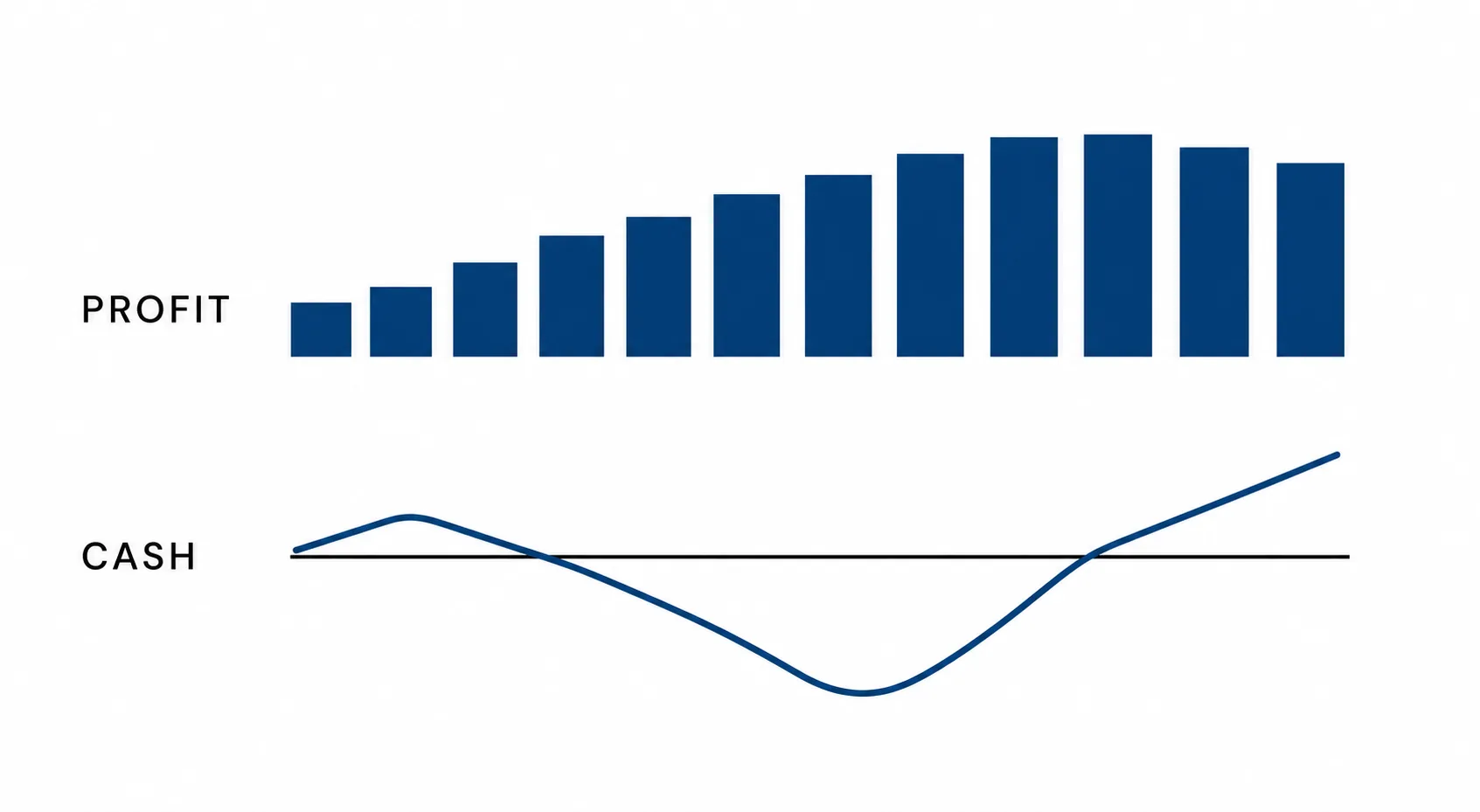
Profit and cash are not the same thing. Profit is what you’ve earned; cash is what you can actually spend today. The gap between them is timing. You pay suppliers, rent, and staff on their schedule, but customers pay you on theirs, and those two calendars rarely line up.
Cash flow itself is simple to define: the money moving into your business (inflows from sales, deposits, and collections) minus the money moving out (outflows for payroll, inventory, rent, and loan payments). The difference over a period is your net cash flow. When outflows lead inflows, even briefly, you feel a squeeze, regardless of what the profit line says.
This matters more than it sounds. Research published in the National Library of Medicine on cash flow management and firm performance links disciplined cash flow management directly to whether firms perform well and stay solvent. Cash management isn’t back-office housekeeping; it’s a survival function.
A business can be growing fast and still run out of cash: scale the top line without managing the timing, and you can sell yourself straight into a cash crisis.
Here’s the part that catches good operators off guard: a business can be growing fast and still run out of cash. Growth consumes cash. Every new order means buying stock, paying labor, and fronting costs weeks before the customer settles the invoice. Scale the top line without managing the timing, and you can sell yourself straight into a cash crisis.
The case against reaching for a loan first
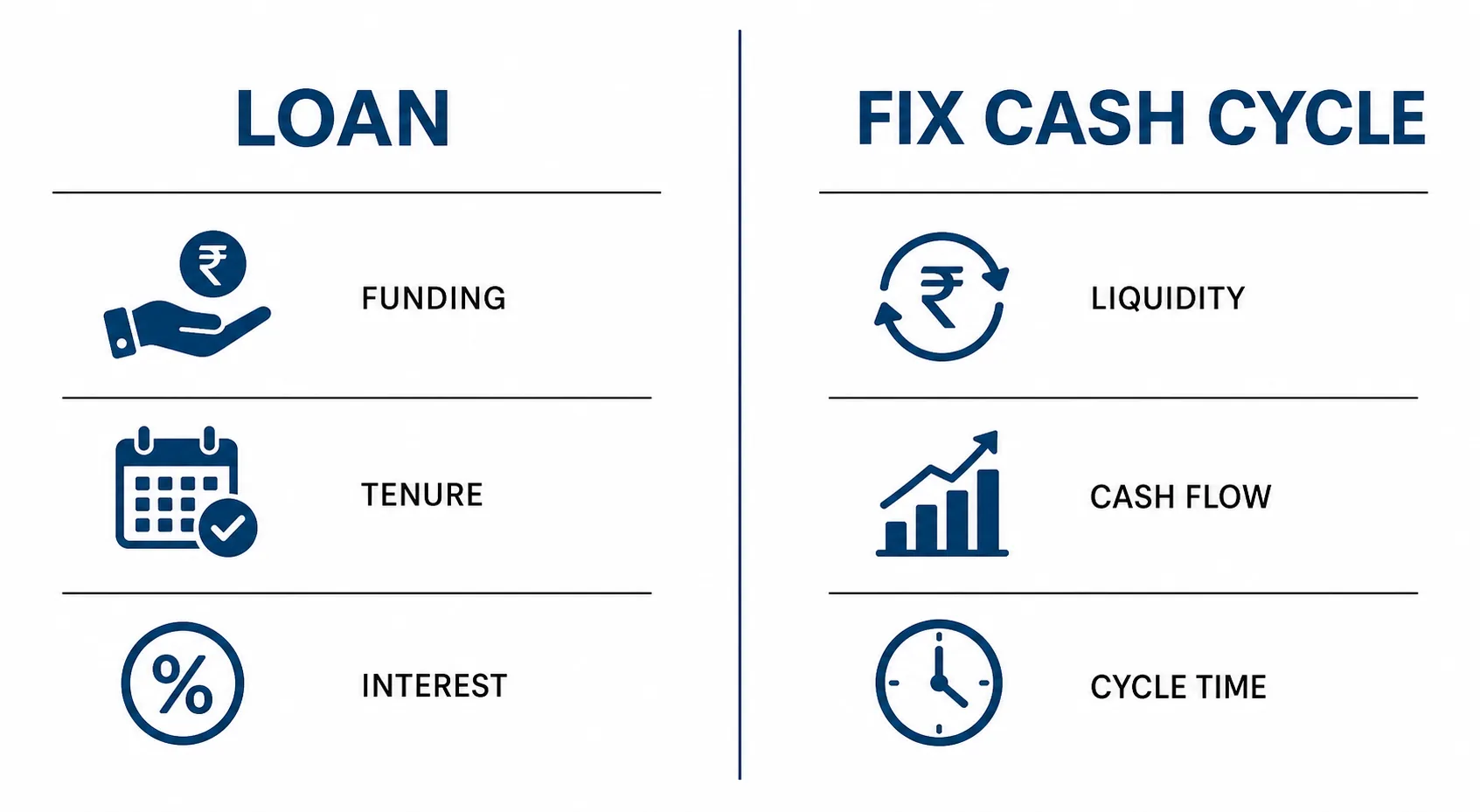
When the account runs low, a loan feels like the obvious fix. Sometimes it is. But borrowing carries costs that go well beyond the interest rate. There are personal guarantees and collateral, often your home or other property, on the line. Approval can take weeks, which is little help when the shortfall is this month. Many facilities come with covenants that restrict how you run the business, and every dollar borrowed reduces your capacity to borrow later, when you may need it more.
There’s a deeper problem, too. A loan papers over a structural gap without fixing it. If customers routinely pay 60 days late and your terms with suppliers are 30, no amount of borrowing changes that underlying mismatch. You’ll be back at the same shortfall next quarter, now with a repayment on top. A study on sustainable cash flow management strategies for small businesses found that the owners who stay liquid focus on the operating cash cycle itself, not on external financing to plug the holes it creates.
The smarter sequence is to fix the cash cycle first. Tighten collections, re-time expenses, and free up trapped cash. Then, if you still need a bridge, you can choose a non-debt option from a position of control rather than panic.
Get paid faster: fix your collections
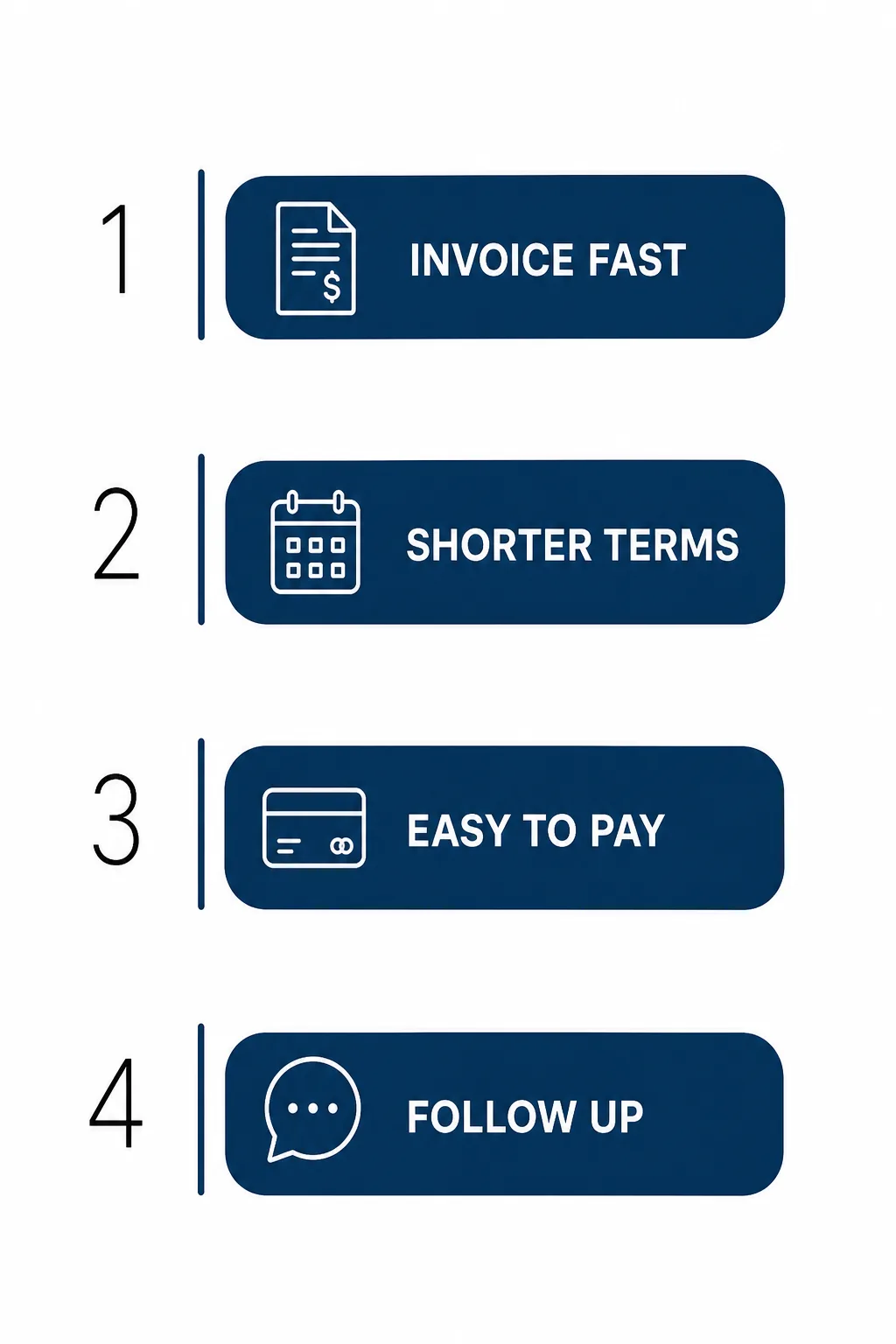
The single highest-leverage debt-free lever is getting paid sooner for work you’ve already done. The cash exists; it’s just sitting in someone else’s account. Accelerating collections converts your own receivables into spendable money without adding a cent of liability.
Invoice immediately and accurately
Send the invoice the moment the job is complete, not at month-end. Every day you wait to bill is a day added to how long you wait to be paid. Batching invoices for the last day of the month can quietly add two or three weeks to your cash cycle for no reason.
Accuracy matters just as much as speed. An invoice with the wrong amount, a missing purchase order number, or an unclear line item gets set aside, disputed, and delayed. Clear, correct invoices with unambiguous terms get processed on the first pass.
Tighten payment terms
Look hard at your standard terms. Shifting from Net 30 to Net 15, or to payment on receipt, can halve the time your cash sits outstanding. For larger jobs, don’t carry the whole cost yourself: ask for a deposit up front and use progress billing so money arrives in stages as the work proceeds rather than all at the very end.
Make paying easy
Every bit of friction is an excuse to delay. Offer multiple payment methods, include a one-click online payment link on every invoice, and set up automated reminders as due dates approach. A small early-payment discount, say two percent for settling within ten days, can nudge slow payers and is often cheaper than the cost of the cash being late.
Follow up systematically
Hope is not a collections strategy. Run an accounts receivable aging report so you always know exactly who owes what and for how long. Then build a defined follow-up cadence: a friendly reminder before the due date, a firmer one the day it passes, and a scheduled escalation after that. Consistency, applied to everyone, collects more than sporadic chasing of whoever you happen to remember.
Turn unpaid invoices into cash without borrowing
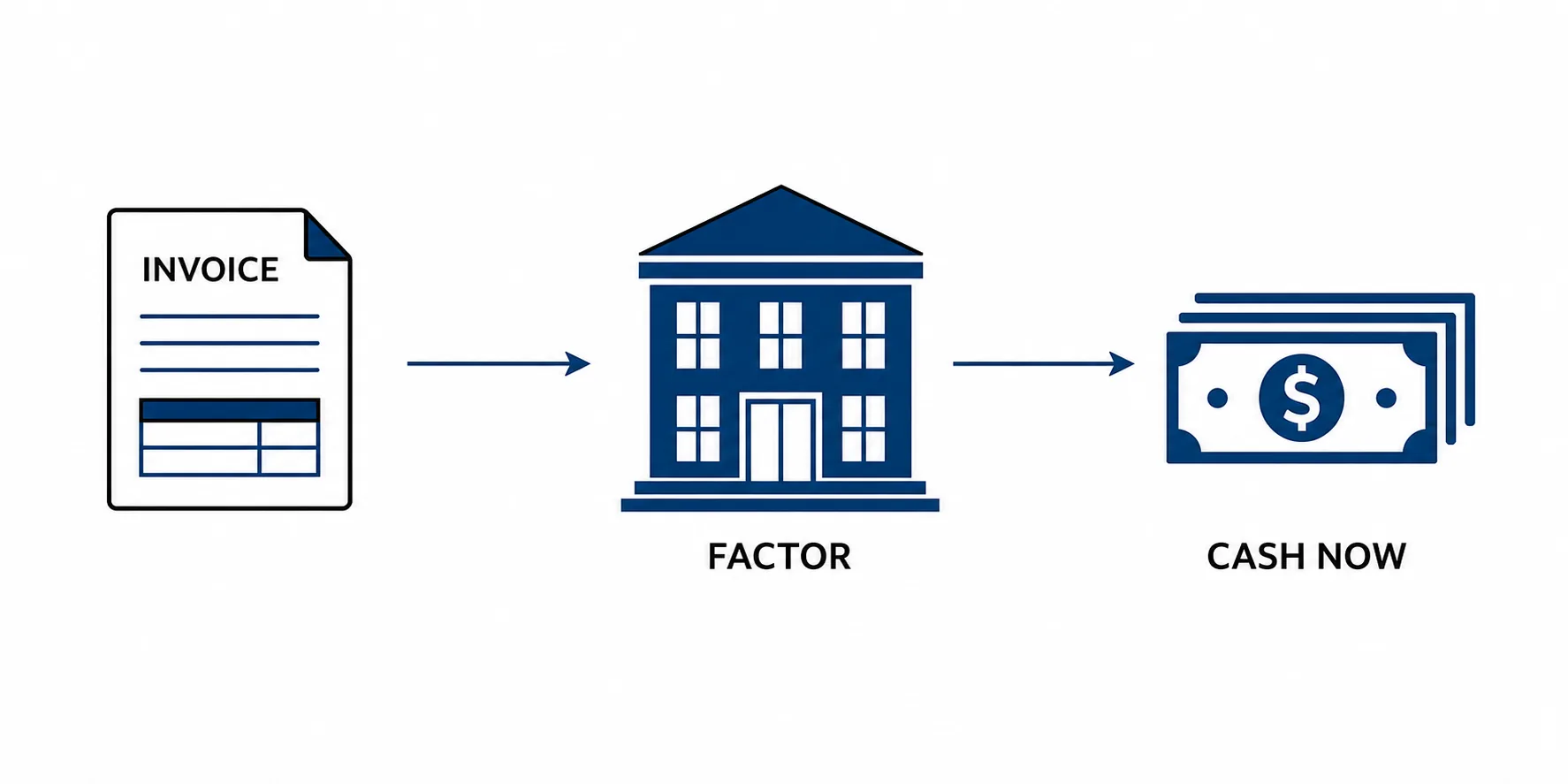
Here is the distinction that unlocks the whole “without debt” question. Taking a loan means creating a new liability: you owe money you didn’t before. Selling or leveraging an asset you already own is different. Your outstanding invoices are an asset, real value you’ve earned and are simply waiting to receive.
Invoice factoring lets you convert that asset into cash now. You sell your unpaid invoices to a factoring partner and receive most of their value immediately, with the balance (less a fee) once your customer pays. Because the funding is backed by the invoice value itself rather than by your property, it doesn’t put a new loan on your balance sheet. It’s cash you’ve already earned, delivered early. For a full breakdown of the mechanics, terms, and where it fits, see this guide on how invoice factoring can help small businesses improve cash flow.
For businesses with long payment cycles or a few large, slow-paying clients, factoring is one of the most direct debt-free ways to smooth cash flow. It scales with your sales rather than with your debt load, and it turns the timing problem into a solved one.
Manage what goes out: reduce and re-time expenses
Speeding up inflows is half the equation. The other half is controlling outflows, both how much leaves and when.
Audit recurring costs
Recurring expenses have a way of accumulating unnoticed. Pull a list of every subscription, service, and standing charge, then question each one. Software seats nobody uses, overlapping tools, memberships that lapsed in usefulness: these add up. Renegotiating with suppliers and vendors, especially longstanding ones, often yields better rates or terms simply because you asked.
Re-time payables (without burning relationships)
Just as you want customers to pay you faster, you can reasonably take the full terms your suppliers offer. If a vendor allows 30 days, using all 30 keeps cash in your account longer, no penalty, no relationship damage. Where you have a good track record, ask key suppliers for extended terms. The goal is to align the timing of your outflows with your inflows so the two calendars stop fighting each other.
Distinguish needs from nice-to-haves
When cash is tight, defer non-critical capital spending. That equipment upgrade or office refresh can usually wait a quarter. When you do need an asset, weigh leasing against buying: leasing preserves cash by spreading the cost instead of draining your reserves in one hit. Neither choice is always right, but making it deliberately protects your buffer.
Increase inflows without discounting your way broke
More revenue helps cash flow only if it’s profitable revenue. Chasing sales through heavy discounts can leave you busier and poorer at once.
Get your pricing right
Pricing is the fastest lever most owners underuse. Even a modest increase flows almost entirely to your bottom line and compounds across every sale. The Australian government’s advice on improving your cash flow highlights getting your pricing right as a first-line move for exactly this reason. Do the margin math, price to the value you deliver rather than to the lowest competitor, and revisit prices you set years ago against today’s costs.
Increase sales from existing customers
Selling to someone who already trusts you costs a fraction of winning a new customer. Look at upsells, complementary products, and repeat-purchase prompts. Improving retention and buying frequency among current clients often does more for steady cash than an expensive acquisition push.
Diversify and steady your income
Lumpy revenue makes cash planning painful. Where your business allows, build in recurring elements: retainers, subscriptions, maintenance plans, or standing orders. Requiring deposits on new work smooths the peaks and troughs. Predictable income is easier to manage than a bigger but erratic top line.
Manage inventory and assets you already have
One of the most overlooked pools of trapped cash sits in your stockroom. Every unit of slow-moving inventory is cash sitting on a shelf, earning nothing and often costing you in storage and obsolescence.
Review your inventory honestly. Discount and clear slow movers to convert dead stock back into working cash, even at a reduced margin. Move toward just-in-time ordering so you hold less between sale and restock. And look at your fixed assets: idle equipment can be sold or leased out, and a sale-leaseback (selling an asset you own, then leasing it back) can release a lump of cash while you keep using the asset, all without a loan.
Build the habit: forecast and monitor cash flow
Everything above is more powerful as prevention than as cure. The tool that makes prevention possible is a rolling 13-week cash flow forecast. Week by week, you project expected inflows against scheduled outflows so you can see a shortfall coming weeks out, while you still have time to act, rather than discovering it the day payroll bounces.
This is also where the difference between a cash flow statement and a profit and loss statement becomes practical. Your P&L tells you whether you’re earning; your cash flow statement tells you whether you can pay. Track the timing, not just the totals: when money is genuinely expected to land and when it’s genuinely due to leave.
Finally, build a cash reserve. A buffer of even a few weeks’ operating costs is what keeps a temporary dip from becoming a forced decision to borrow. The reserve is what lets you say no to expensive money when the pressure is on.
Frequently asked questions
Should I take a loan to improve cash flow?
What’s the fastest way to improve cash flow without borrowing?
Is invoice factoring the same as taking on debt?
What is a healthy cash flow for a small business?
How is cash flow different from profit?
The bottom line
Most cash-flow gaps are timing problems, and timing problems are fixable from inside the business. Invoice faster and tighter, make paying easy, chase what you’re owed on a schedule, trim and re-time your outgoings, price for margin, and free up cash trapped in stock and idle assets, all while a rolling forecast keeps you ahead of the next squeeze. Work these levers and borrowing often stops being necessary at all. When internal fixes aren’t enough on their own, a non-debt option like invoice factoring can bridge the gap using money you’ve already earned, and Dash Capital can help you put that to work without adding a loan to your books.
