Secured business loans use collateral. Unsecured business loans do not require a specific pledged asset. The right choice depends on how much money your business needs, how fast you need it, what assets you can safely pledge, and whether your cash flow can support repayment. In this article, we explore the key differences between secured and unsecured business loans, how each option works, and how small business owners can compare funding options with greater confidence.
What Is the Difference Between Secured and Unsecured Business Loans?
The main difference between secured and unsecured business loans is that secured loans require collateral, while unsecured loans do not require a specific pledged asset. Collateral can include real estate, equipment, inventory, vehicles, receivables, or other business assets. If the borrower defaults on a secured loan, the lender may have the right to claim or sell the pledged asset to recover the debt.
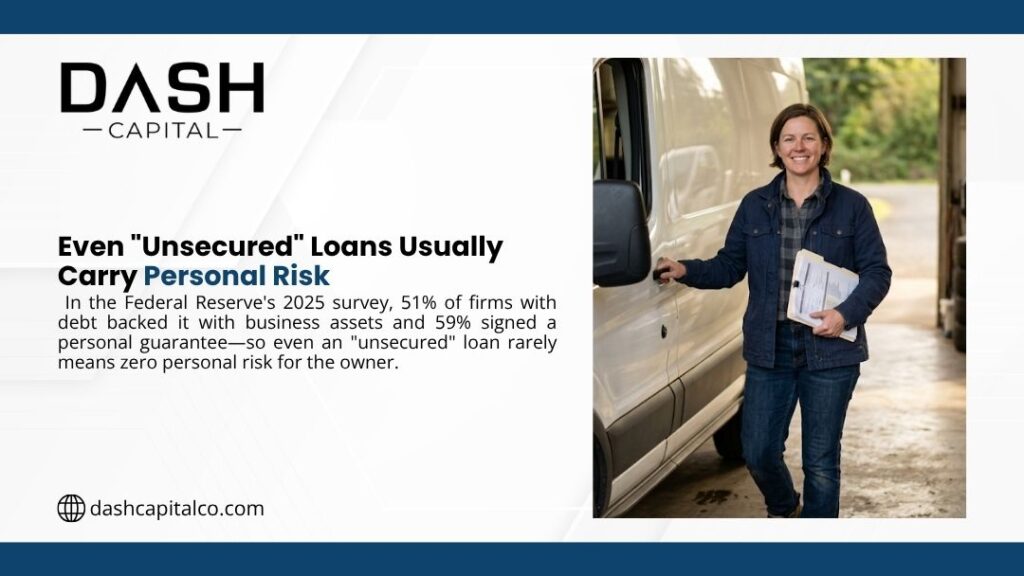
An unsecured business loan works differently. It is not backed by a specific asset. Instead, lenders review credit score, revenue, cash flow, time in business, bank activity, and credit history. Some unsecured loans may still require a personal guarantee, which means the owner personally agrees to repay the debt if the business cannot. So “unsecured” does not always mean “no risk.” It means the loan is not directly secured by named collateral.
That is why the difference between secured and unsecured loans matters before you sign anything. Secured loans may offer larger loan amounts, lower interest rates, and longer repayment periods. Unsecured loans may offer faster access, shorter repayment, less paperwork, and no need to put equipment or property on the line.
The U.S. Small Business Administration explains it clearly: “In a nutshell, unsecured funding does not require you to pledge collateral, whereas secured funding requires you to pledge valuable assets that you or your business owns.” That definition brings the decision back to the real issue: what are you willing to pledge, and how quickly does your business need capital?
What Is a Secured Business Loan?
A secured business loan is a type of business financing backed by collateral. In plain English, a secured loan is a loan where the lender has a backup source of repayment if the borrower does not repay the loan as agreed.
Common secured debt examples include commercial mortgages, equipment loans, vehicle loans, some SBA loans, and business loans secured by real estate. A secured bank loan may also use inventory, accounts receivable, machinery, or cash savings as security.
A secured loan can help a business qualify for more capital because the lender has less risk. That is why secured loans are often used for larger purchases, long-term projects, expansion, commercial property, equipment upgrades, or debt refinance. If you are buying machinery for a construction company, upgrading a medical office, opening a second restaurant, or purchasing vehicles for a trucking company, secured business finance may make sense.
The trade-off is simple. You may get better rates and terms, but the asset is at risk if the business cannot repay the loan. That risk should not be brushed aside. A secured loan is backed by property or business assets for a reason. The lender wants protection.
What Is an Unsecured Business Loan?
An unsecured business loan is funding that does not require a specific asset as collateral. Lenders approve the loan based on the business’s financial strength, revenue, credit score, bank deposits, cash flow, and repayment ability.
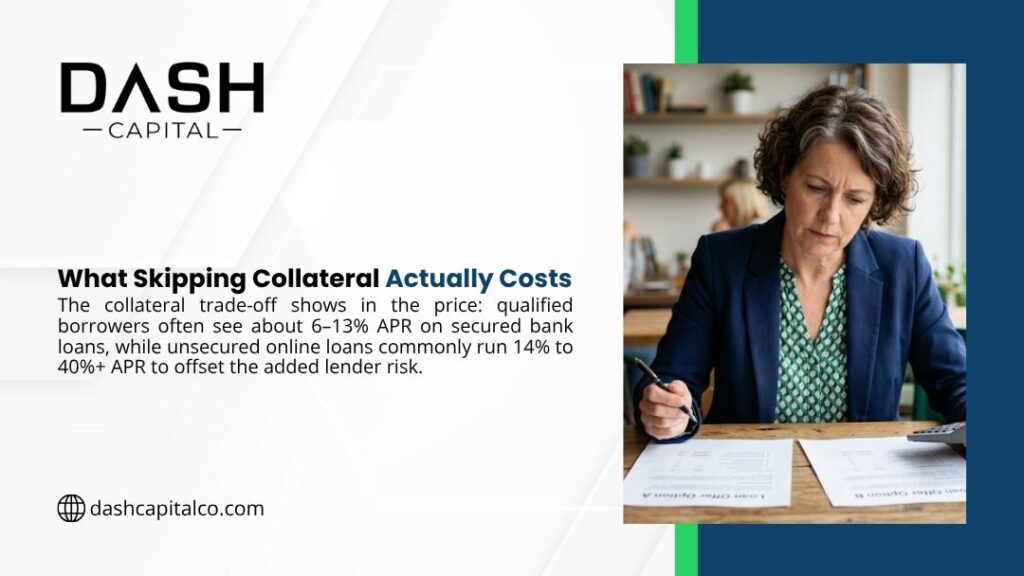
So, what does an unsecured loan mean for a business owner? It means the lender is not asking you to pledge equipment, real estate, or inventory as direct security for the loan. It also means the lender may charge higher interest rates compared to secured loans because there is more lender risk.
Unsecured debt examples include many business credit cards, some short-term business loans, merchant cash advances, certain business lines of credit, and some working capital loans. Credit card debt is usually unsecured debt. Student loans are usually unsecured debt as well, although they are not business loans. A mortgage, by contrast, is secured debt because the home backs the loan.
An unsecured business loan can work well for short-term needs such as payroll, inventory, marketing, repairs, supplier bills, seasonal dips, or cash flow gaps. Dash Capital’s working capital loan options are built for this kind of practical need: quick access to capital when a business expense cannot wait for a slow bank review.
Secured Loan vs Unsecured Loan: Side-by-Side Comparison
The secured loan vs unsecured loan decision should not be based on one feature alone. A lower rate is helpful, but not if the loan takes too long or puts a critical asset at risk. Fast funding is useful, but not if the payment schedule strains cash flow.
| Feature | Secured business loan | Unsecured business loan |
| Collateral | Requires business or personal assets as security | No specific collateral required |
| Approval basis | Collateral, credit history, revenue, cash flow, business assets | Credit score, revenue, cash flow, bank activity, time in business |
| Typical loan amount | Often larger loan amounts | Often, smaller loan amounts |
| Interest rates | Often lower because lender risk is reduced | Often higher because lender risk is greater |
| Repayment | May allow longer loan terms | Often shorter repayment |
| Funding speed | Can take longer due to valuation and documentation | Often faster because there is no collateral appraisal |
| Borrower risk | You could lose the pledged asset if you default | No named collateral is pledged, but credit damage, collections, legal action, or personal guarantee risk may still apply |
| Best use | Equipment, real estate, expansion, long-term investment | Payroll, working capital, inventory, marketing, and urgent cash flow needs |
For business owners in Livonia, Metro Detroit, and across Michigan, Dash Capital’s value is not just speed. It is the ability to compare options with a real funding advisor instead of guessing which loan type fits best. Their process is designed around simple documentation, fast review, and funding options that match business revenue, not just a bank checklist.
Why Are Secured Loans Considered Less Risky to the Lender?
Secured loans are considered less risky to the lender because the lender has collateral to recover part of the loss if the borrower defaults. If a borrower stops making payments on a secured loan, the lender may be able to repossess equipment, claim receivables, place a lien, or pursue other rights listed in the loan agreement.
That lender protection is the reason secured loan interest rates are often lower. The collateral reduces uncertainty. Because the lender has a second way to recover money, secured loans may allow larger loan amounts, longer repayment terms, and more flexible approval guidelines.
But lower lender risk can mean higher borrower risk. If your restaurant equipment, delivery truck, or commercial property backs the loan, missed payments can create real problems. Before signing, ask what asset secures the loan, how the lender values it, what happens after default, and whether a personal guarantee is also required.
When a Secured Business Loan Makes Sense
A secured business loan may be a good fit when the business needs a larger amount, has valuable collateral, and can manage a longer repayment plan. It may also help when the business has imperfect credit but strong assets or stable revenue.
For example, a manufacturing company may use equipment as collateral to finance a new machine. A medical practice may use financing for renovations. A restaurant group may pledge business assets to support expansion. A trucking company may secure funding against vehicles. In these cases, the asset and the loan purpose are often connected.
Secured loans also work well when the return on the investment is clear. If a $90,000 equipment purchase can increase monthly production, reduce labor costs, or open a new revenue stream, a secured term loan may be easier to justify. The business gets predictable payments, and the lender has collateral.
Some term loans may be secured, while others may be structured differently depending on lender requirements, credit profile, cash flow, and the loan amount. Dash Capital’s term loan guidance focuses on fixed financing for business growth, predictable payments, and funding that fits the company’s operating needs rather than treating every term loan as one-size-fits-all.
When an Unsecured Business Loan Makes Sense
An unsecured business loan may make sense when the business needs speed, has healthy revenue, and does not want to pledge assets. It can also help asset-light companies such as consultants, agencies, professional services, small retailers, and certain startups that do not own major equipment or real estate.
Unsecured business lending is often used for working capital. That can include payroll, supplier payments, inventory, emergency repairs, short-term marketing, seasonal slowdowns, or a cash gap between invoices and deposits.
For many small businesses, speed matters. A bank loan may offer attractive terms, but that does not help much if payroll is due Friday. Dash Capital’s process is built around a faster path: apply online, share the essentials, get reviewed by a funding advisor, and compare options without piles of bank paperwork. For many working capital needs, Dash Capital states that funding may be available within 24–48 hours after approval and completed documentation.
The drawback is cost. Since unsecured lending carries more risk for the lender, rates can be higher, and repayment terms may be shorter. That does not make unsecured loans bad. It means the loan should be matched to a short-term purpose and a realistic repayment plan.
Are Small Business Loans Secured or Unsecured?
Small business loans can be secured or unsecured. There is no single answer because business loans come in several forms. A small business loan from a bank may be secured by business assets. An online working capital loan may be unsecured. An SBA loan may require collateral depending on the program, size, and lender policy. A business line of credit can be secured or unsecured. Equipment financing is usually secured by the equipment being purchased.
| Loan type | Usually secured or unsecured? | Common use |
| Equipment financing | Usually secured | Buying machinery, vehicles, tools, or equipment |
| Commercial mortgage | Secured | Buying or refinancing business property |
| Working capital loan | Often unsecured, but varies | Payroll, inventory, rent, marketing, repairs |
| Business line of credit | Can be secured or unsecured | Cash flow gaps, seasonal costs, and flexible purchases |
| Business credit card | Usually unsecured | Everyday expenses, travel, small purchases |
| SBA loan | Can involve collateral, depending on size and program | Expansion, working capital, equipment, and real estate |
| Invoice factoring | Tied to receivables | Turning unpaid invoices into cash |
This is why the question “Is a small business loan secured or unsecured?” needs a second question behind it: what type of loan are you applying for, and what is the lender using to approve it?
How Collateral, Credit Score, and Cash Flow Affect Approval
Lenders rarely look at only one thing. Even with secured loans, collateral is not the whole story. Lenders still review credit score, business revenue, time in business, bank statements, debt levels, and repayment ability. A valuable asset helps, but it does not erase weak cash flow. If a lender has flagged your numbers, it is worth understanding the root causes of weak cash flow so you can address them before you apply again.
For unsecured loans, cash flow carries even more weight. Since no specific asset backs the loan, the lender wants to see that the business can repay from normal operations. Bank deposits, revenue consistency, credit history, and existing debt matter.
The Federal Reserve’s 2025 Report on Employer Firms, based on the 2024 Small Business Credit Survey, shows why this matters. Among employer firms surveyed, 59% sought new financing in the 12 months leading up to the survey. The most common reasons were meeting operating expenses and pursuing expansion or a new opportunity. More than half of firms also cited paying operating expenses or uneven cash flow as financial challenges.
That tells us approval is not just about wanting capital. It is about proving the business can handle it. For a lender, strong deposits, steady revenue, and a clear use of funds can matter as much as the loan label itself.
Secured vs Unsecured Debt Examples in Plain English
Sometimes, the easiest way to understand secured vs unsecured debt is through familiar examples.
| Question | Answer |
| Is a mortgage secured or unsecured? | A mortgage is secured debt because the home backs the loan. |
| Is credit card debt secured or unsecured? | Most credit card debt is unsecured debt because no specific asset backs the balance. |
| Is a student loan secured or unsecured? | A student loan is usually unsecured because it is not backed by collateral like a home or vehicle. |
| Is equipment financing secured or unsecured? | It is usually secured because the equipment can serve as collateral. |
| Is a business loan without any security possible? | Yes, but approval may depend more heavily on revenue, cash flow, credit score, and time in business. |
| Are SBA loans secured or unsecured? | It depends on the loan amount, program, and lender policy. Some smaller SBA loans may not require collateral, while larger loans may involve available business assets. |
These examples show why “secured” and “unsecured” are not just finance terms. They decide what happens if the business hits a rough patch.
Before You Choose: A Practical Business Loan Checklist
| Ask this before you apply | Why it matters |
| How fast do I need the funds? | If the need is urgent, an unsecured working capital loan or line of credit may move faster than a collateral-heavy loan. |
| What asset would secure the loan? | If the pledged asset is critical to daily operations, the risk may be too high. |
| Can my cash flow support the payment? | A loan should relieve pressure, not create a tighter cash-flow problem next month. |
| Is the money for a short-term need or a long-term asset? | Short-term needs often fit working capital. Long-term purchases may fit term loans or equipment financing. |
| Am I comparing more than one option? | Side-by-side offers can show differences in rate, repayment, fees, term length, and collateral language. |
| Do I understand the personal guarantee? | Even an unsecured loan may still carry personal responsibility if the agreement requires it. |
This is also where Dash Capital’s advisor-led model can help. A business owner may know they need capital, but not whether the best fit is a working capital loan, term loan, line of credit, equipment financing, or another funding structure. The advisor review helps narrow that choice before the business commits.
How to Choose Between Secured and Unsecured Business Financing
Start with the purpose of the loan. If you are buying a long-term asset, a secured loan may fit better. If you need quick working capital, an unsecured business loan may make more sense. If the loan is for payroll, inventory, or a short cash-flow gap, you probably do not want a drawn-out approval process built around appraisals and legal documents.
Next, look at the amount. Larger loan amounts are more likely to require collateral. Smaller short-term loans may be available without collateral, especially if the business has steady revenue.
Then review repayment. Secured loans may offer longer repayment periods, which can reduce monthly pressure. Unsecured loans may carry shorter repayment terms, which can work if the money solves a near-term problem and revenue is expected soon.
Finally, be honest about risk. If losing a pledged asset would hurt the business badly, pause before choosing secured debt. If a higher payment would strain cash flow, pause before choosing unsecured debt. Neither option is automatically safer. The safer loan is the one your business can repay without choking operations.
A Smarter Way to Compare Business Loan Options
The best move is to compare options side by side before committing. That is where a funding advisor can help. Instead of pushing one product, a good advisor looks at business assets, bank statements, revenue, timing, credit history, and funding purpose.
Dash Capital positions itself as a faster, more flexible alternative to the usual bank process. The company offers working capital loans, term loans, lines of credit, SBA loans, equipment financing, factoring, and other funding options for small businesses. Its process is built around minimal documentation, quick approvals, and matching business owners with funding options that fit real cash flow.
If you need fast capital for payroll, inventory, marketing, repairs, or seasonal costs, a working capital loan may fit. If you need structured funding for expansion, renovation, hiring, or equipment, a term loan may be better. If you want to compare several types of business financing in one place, Dash Capital’s loan products give a broader view of available options.
For Michigan business owners and companies across many industries, Dash Capital’s funding process is designed to reduce delays and help owners compare practical options before they choose. You can also review the company’s simple funding process before you apply.
FAQs About Secured and Unsecured Business Loans
Do secured loans have lower interest rates?
Secured loan rates are often lower because collateral reduces the lender’s risk. Still, the actual rate depends on credit score, loan amount, repayment term, business revenue, collateral value, and lender policy.
Are unsecured loans always more expensive than secured loans?
Not always, but unsecured loans often have higher interest rates compared to secured loans. The total cost also depends on fees, repayment length, payment frequency, and how quickly the loan is repaid.
Can you get a small business loan without collateral?
Yes, some small business loans are available without collateral. Business loans with no collateral may rely more on cash flow, revenue, bank statements, credit history, and time in business.
Are secured loans bad?
Secured loans are not bad by default. They can offer lower rates, larger loan amounts, and longer repayment terms. The risk is that the pledged asset may be lost if the loan is not repaid.
What are examples of unsecured debt?
Examples of unsecured debt include many credit cards, student loans, some personal loans, and certain unsecured business loans. These debts are not tied to one specific pledged asset.
What happens if a secured loan is not repaid?
If a secured loan is not repaid, the lender may pursue the collateral listed in the loan agreement. The borrower may also face credit damage, fees, collections, legal action, or other consequences.
Which loan is better for working capital?
For short-term working capital needs, an unsecured business loan or line of credit may work well because it can be faster and may not require collateral. For larger long-term working capital needs, a secured option may offer better rates and terms.
Choose Funding That Fits the Way Your Business Works
The real answer to what is the difference between secured and unsecured business loans comes down to more than collateral. It comes down to timing, cost, risk, cash flow, and the reason you need funds in the first place.
A secured business loan may be right when you need a larger amount, have assets to pledge, and want longer repayment terms. An unsecured business loan may be better when speed matters, you do not want to risk specific business assets, and your revenue can support the repayment schedule.
Before you choose, compare both options with care. Look at the loan amount, interest rate, repayment term, fees, collateral language, personal guarantee, and payment schedule. A loan should help the business breathe, not box it in.
Dash Capital helps business owners review funding options without the usual bank hassle. If your business needs capital for payroll, inventory, cash flow, equipment, expansion, or a time-sensitive opportunity, speak with a Dash Capital funding advisor or start with a simple online quote request.
