
Profitable businesses still fail. A company can book strong sales all year and still miss payroll because the cash arrives after the bills are due. The U.S. Small Business Administration treats managing cash flow as central to keeping a business open. Cash flow forecasting is the tool that fixes the timing problem. This guide defines it, shows the mechanics behind how it works, walks through a worked example, and gives you a repeatable method you can build this week.
What Is Cash Flow Forecasting?
Cash flow forecasting is an estimate of the cash moving into (inflows) and out of (outflows) your business over a set future period, producing a projected closing cash balance for each week or month. Instead of guessing whether you can cover next month’s rent, you calculate it.
Cash Flow Forecast Meaning in Business
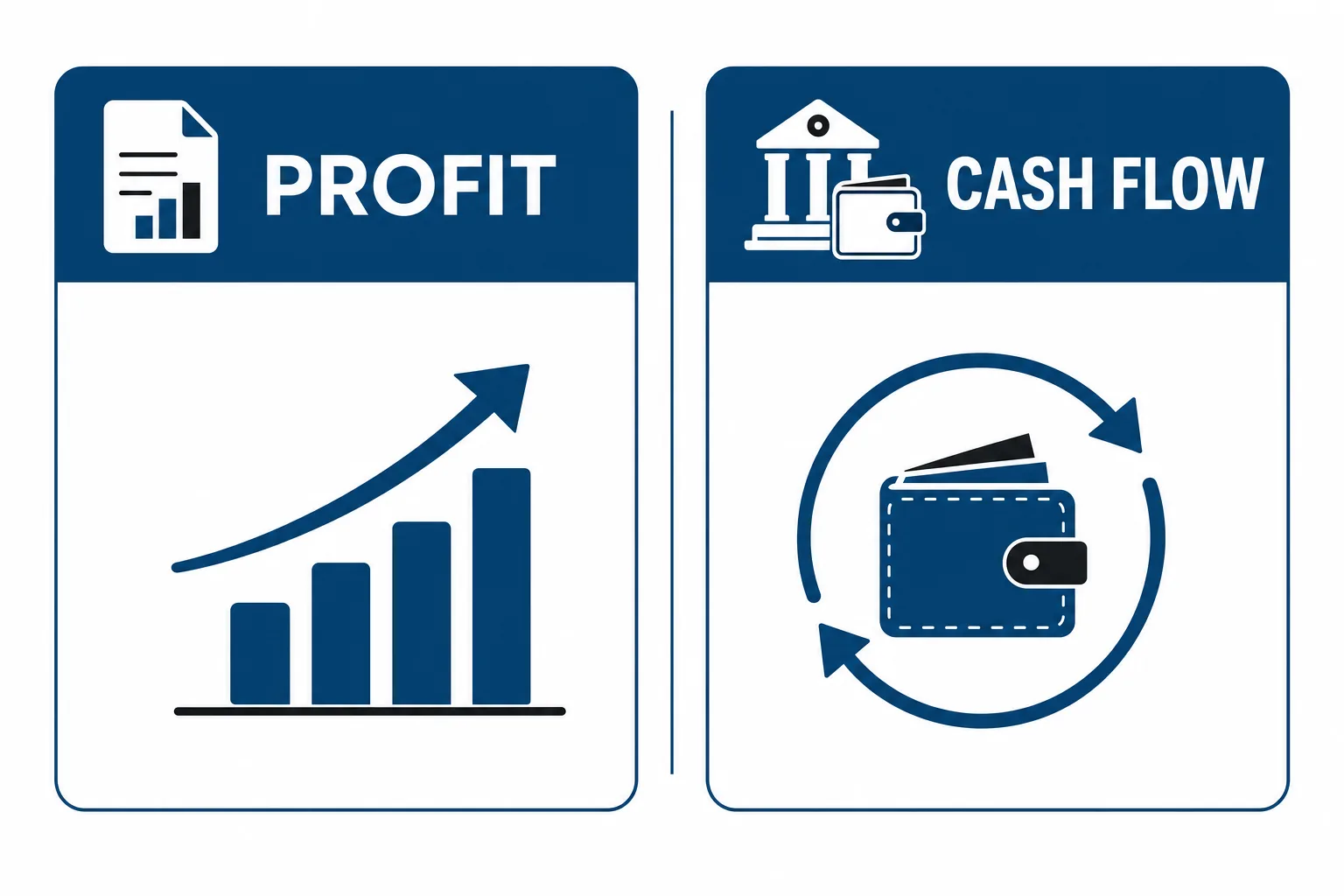
In plain business terms, a cash flow forecast tracks the timing of actual cash, not accrued revenue. It answers a single practical question: how much money will actually be in the bank on a given date? That makes it different from a profit and loss statement, which records income when it is earned and expenses when they are incurred, regardless of when cash changes hands.
Cash Flow vs. Profit
This distinction trips up more owners than any other. Profit is what remains after revenue minus expenses on paper. Cash flow is money physically available. You can invoice a customer $20,000 in March (profit on the books) but not collect it until June. Meanwhile payroll, rent, and suppliers all need paying in March. The forecast captures that gap; a profit statement hides it.
Why Is Cash Flow Forecasting Important?
A forecast lets you spot shortfalls before they hit, time large outflows like tax bills or equipment purchases, and plan hiring or inventory with confidence. It also strengthens loan applications, because lenders want to see that you understand your own numbers.
There is a financing angle worth naming plainly. A forecast shows you when a cash gap appears and how large it is. That is the precise input for deciding whether a working-capital line or a small business loan should bridge it. The Federal Reserve Banks’ Small Business Credit Survey consistently finds that cash flow and covering operating expenses rank among the top reasons small firms seek financing. Knowing the size of the gap in advance means you borrow on your terms, not in a panic.
Knowing the size of the gap in advance means you borrow on your terms, not in a panic.
How Does Cash Flow Forecasting Work?
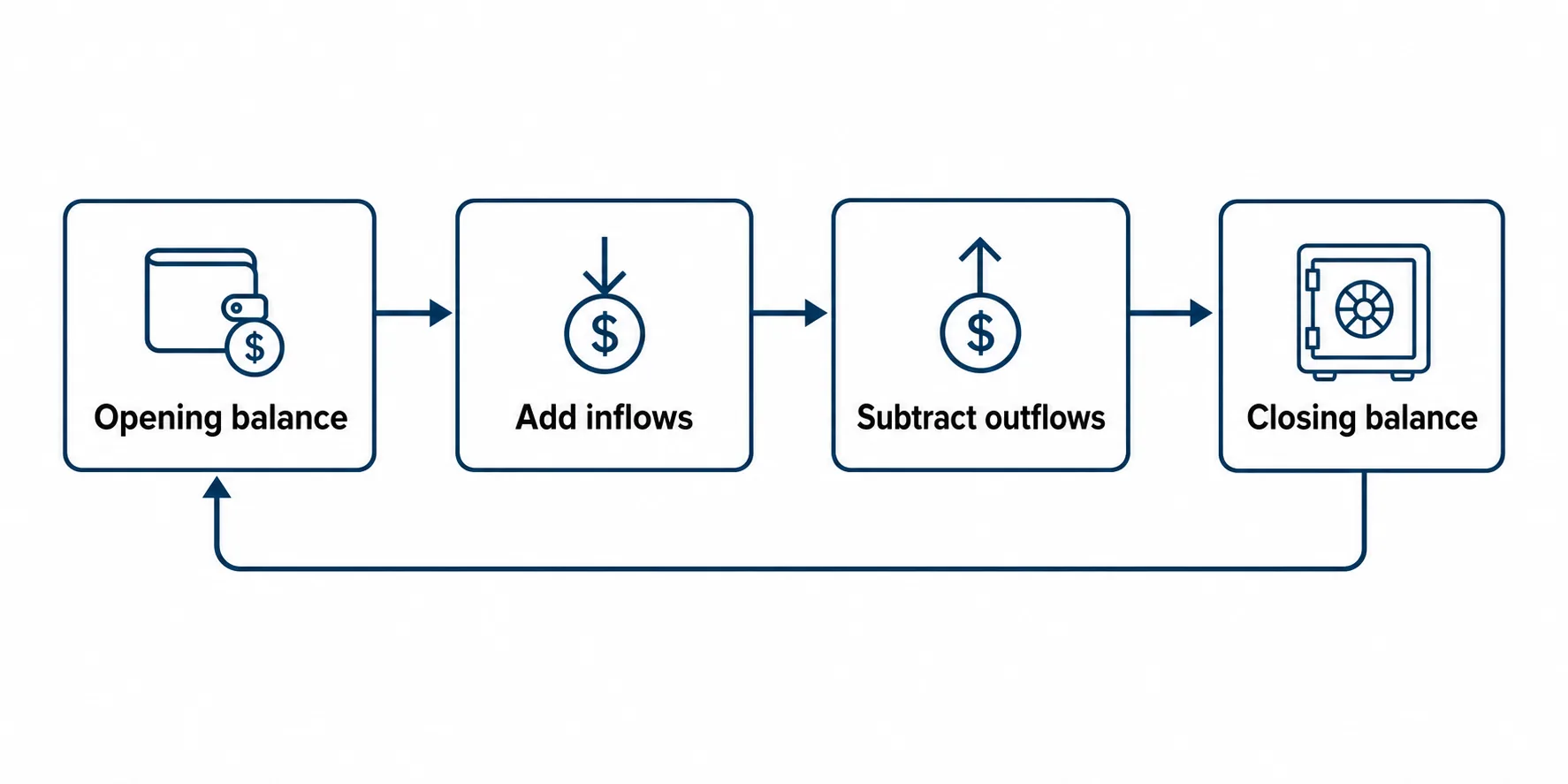
The mechanism is straightforward arithmetic applied period by period:
- Start with your opening cash balance, the money in the bank at the start of the period.
- Add projected inflows: sales receipts, collections on accounts receivable, loan proceeds, tax refunds.
- Subtract projected outflows: payroll, rent, supplier payments, loan repayments, taxes.
- Calculate net cash flow (inflows minus outflows) and your closing balance (opening plus net). That closing balance becomes the opening balance for the next period.
Cash Flow Forecast Formula
Stated cleanly:
Closing balance = Opening balance + Total inflows − Total outflows
Repeat that line for each week or month, carrying each closing figure forward, and you have a rolling forecast.
Key Components of a Forecast
Every forecast, however simple, contains the same building blocks: opening balance, projected inflows, projected outflows, net cash flow, closing balance, and time buckets (typically weekly for tight operations or monthly for planning). Get those six elements right and the rest is detail.
Cash Flow Forecast Example
Here is an illustrative three-month forecast. The numbers are structural samples, not real figures, and the point is the pattern, not the amounts.
| Month 1 | Month 2 | Month 3 | |
|---|---|---|---|
| Opening balance | $10,000 | $12,000 | $2,000 |
| Inflows (receipts) | $18,000 | $14,000 | $22,000 |
| Outflows (payroll, rent, suppliers) | $16,000 | $24,000 | $17,000 |
| Net cash flow | +$2,000 | −$10,000 | +$5,000 |
| Closing balance | $12,000 | $2,000 | $7,000 |
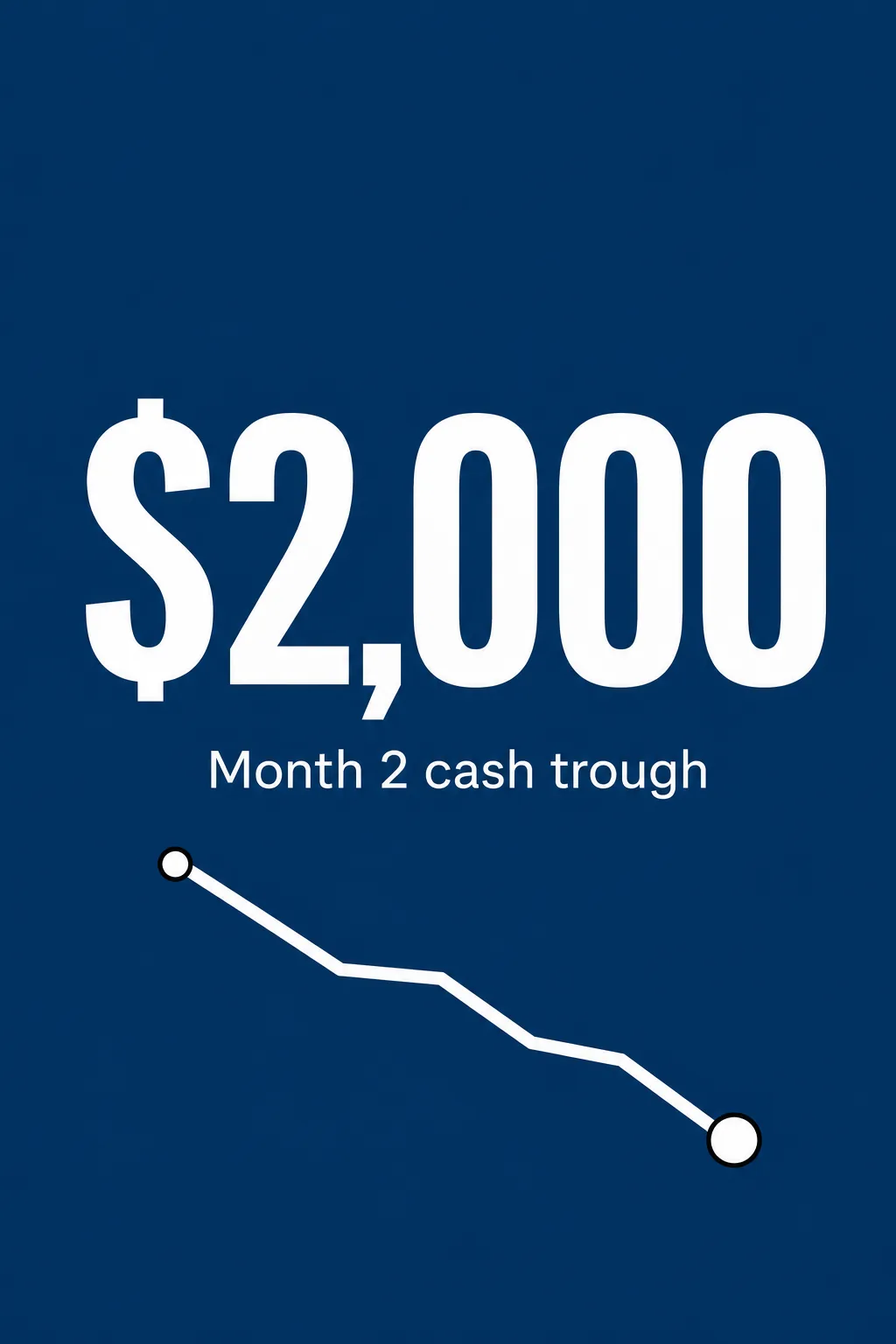
Month 2 is the warning. A large supplier bill and quarterly payments cluster while receipts dip, and the closing balance nearly hits zero. Caught a month ahead, the owner has options: defer non-essential spend, accelerate collections by invoicing early or offering a small prompt-payment discount, or arrange a short-term facility to smooth the trough. Caught on the day the account runs dry, there are no good options left.
Cash Flow Forecasting Methods and Techniques
The Two Types of Cash Flow Forecasting
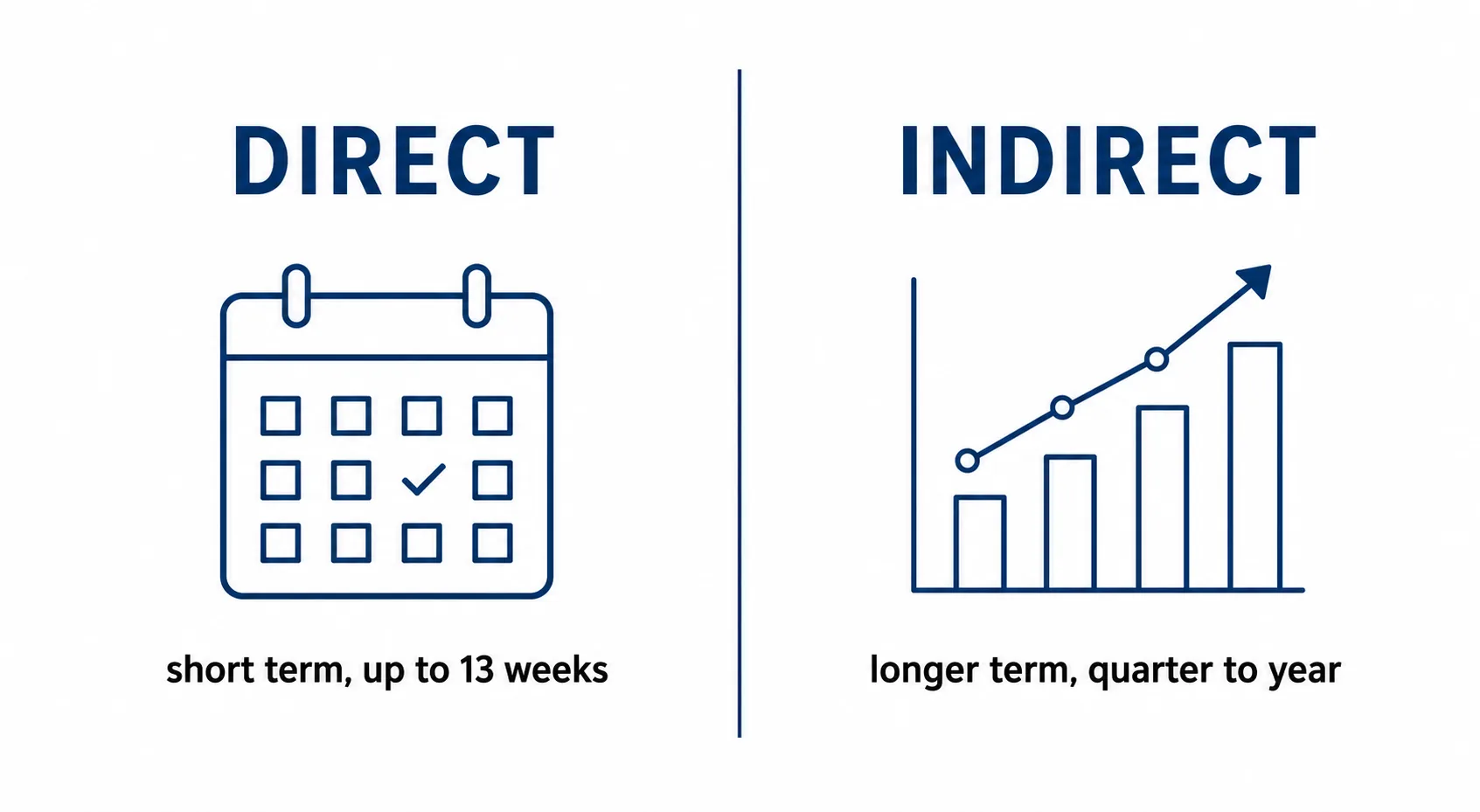
There are two main approaches. Direct forecasting builds the picture from actual expected receipts and disbursements, line by line. It is granular and best for short horizons, typically up to 13 weeks, where you need day-to-day accuracy. Indirect forecasting starts from your projected profit and loss and balance sheet, then adjusts for non-cash items. It is less precise but well suited to longer horizons of a quarter to a year, where directional planning matters more than exact daily balances. Many businesses run both: direct for the near term, indirect for the annual view.
| Direct forecasting | Indirect forecasting | |
|---|---|---|
| Built from | Actual expected receipts and disbursements, line by line | Projected profit and loss and balance sheet, adjusted for non-cash items |
| Precision | Granular, day-to-day accuracy | Less precise, directional planning |
| Best horizon | Short, typically up to 13 weeks | Longer, a quarter to a year |
Common Techniques and Model Choices
A rolling forecast updates continuously, always looking the same number of periods ahead so you never run out of runway. Scenario or sensitivity analysis models best-case, base-case, and worst-case versions so a single optimistic assumption cannot blindside you. SCORE, the SBA’s nonprofit mentoring partner, offers free guidance and worksheets on building financial projections if you want a structured starting point.
How to Build a Cash Flow Forecast (Step by Step)
- Define your objective and time horizon. Survival planning, growth, and a loan application each call for different detail.
- Choose a time frame: weekly or a 13-week rolling view for tight cash, monthly for broader planning.
- List and estimate your inflows, using historical patterns and your sales pipeline.
- List and estimate your outflows, including irregular ones like tax and insurance.
- Calculate net cash flow and closing balances, rolling each period forward.
- Review actual results against your forecast each cycle and adjust the assumptions that missed.
How Often Should You Forecast Cash Flow?
Cadence depends on how tight your cash is. Businesses managing a narrow buffer should run a 13-week rolling forecast and refresh it weekly. More stable operations can review monthly. The rule of thumb: forecast at least as often as you make significant spending decisions.
Tools for Cash Flow Forecasting
Cash Flow Forecast Template (Excel or Sheets)
A spreadsheet is the most accessible starting point, and for many small businesses it is all you need. A good template has one column per period, clearly separated rows for each inflow and outflow category, and formulas that carry the closing balance forward automatically. Build it once and you reuse it every cycle.
Beyond spreadsheets, most accounting platforms now include built-in forecasting that pulls from your live transaction data, and dedicated forecasting tools add scenario modeling and automation as you scale. Choose based on how much manual entry you want to eliminate, not on features you will never open.
Common Cash Flow Forecasting Mistakes to Avoid
- Over-optimistic sales timing. Assuming customers pay on the invoice date rather than when they actually pay.
- Ignoring late payments. Build in realistic collection lags based on your history.
- Forgetting irregular outflows. Annual tax, insurance premiums, and equipment purchases wreck forecasts that only track monthly bills.
- No scenario planning. A single forecast is a guess; three scenarios is a plan.
- Set and forget. A forecast you never revisit is worthless. Compare forecast to actual and update.
Turning Your Forecast Into Action
A forecast only earns its keep when it drives decisions. When it flags a shortfall you cannot smooth with timing alone, that is your signal to line up financing before the crunch, not during it. Businesses that borrow from a position of strength, with a clear forecast in hand, tend to secure better terms than those scrambling to cover a gap that has already opened.
That is where working capital fits. When your forecast reveals a funding gap that faster collections or deferred spending cannot close, a working-capital line or a small business loan can bridge it cleanly. At Dash Capital, we help small businesses access that capital at the moment the forecast says they need it, so a predictable dip never becomes a crisis.
